North Country Healthcare Survey Connects Women’s Health, Childhood Trauma
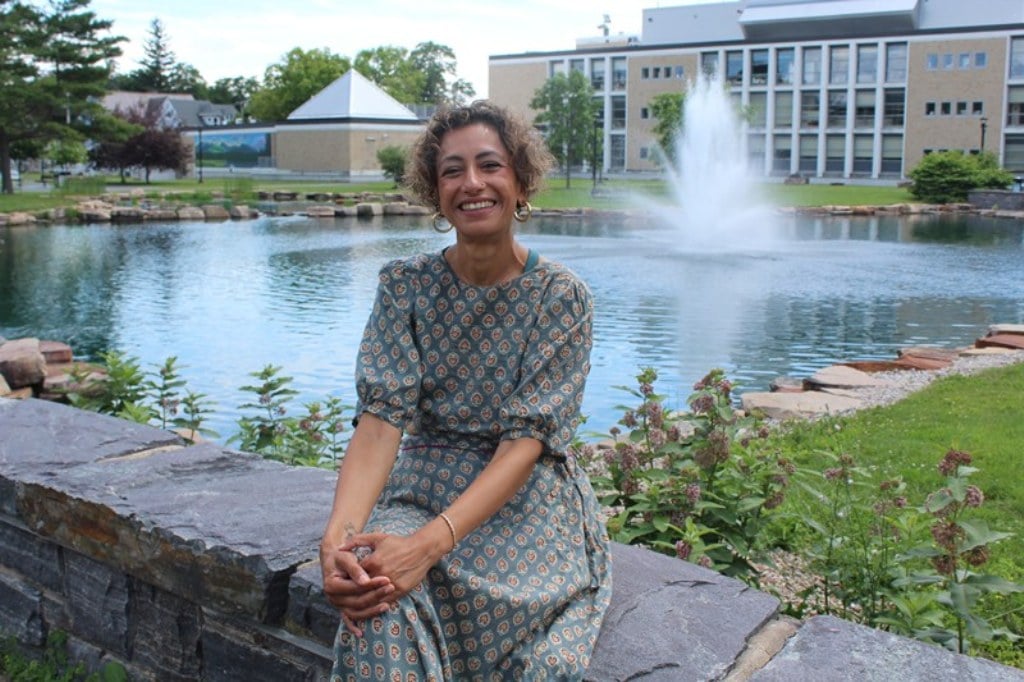
A SUNY Plattsburgh Department of Gender and Women’s Studies faculty member recently teamed up with a Jefferson Community College research-and-analysis center to conduct a North Country health and healthcare study.
Dr. Akanksha Misra, associate professor in gender and women’s studies, and the JCC Center for Community Studies completed a first-of-its-kind study on North Country residents’ health and healthcare experiences with special emphasis on women’s health and the impact of adverse childhood experiences.
Based on Misra’s findings from a 2023 SUNY Plattsburgh campus survey on polycystic ovary syndrome, the North Country study reached out to adults in Clinton, Essex, Franklin, Jefferson and St. Lawrence counties between Feb. 3 and 14 of this year. Nearly 3,000 responded.
Misra’s research background includes sex education and menstrual issues such as PCOS — now known as polyendocrine metabolic ovarian syndrome, or PMOS — in rural and North Country communities.
“In 2023, I had a lot of students from the North Country and New York City who were talking about menstrual health — PMOS, endometriosis. I had a student who had to travel home to have bariatric surgery for PMOS.”
Polyendocrine metabolic ovarian syndrome is a hormone health issue affecting women of childbearing age. It can cause irregular periods, ovarian cysts, male-pattern hair growth and other symptoms. Through her own research, Misra was aware there may be a connection between women with PMOS and childhood trauma.
PMOS ‘Only Part of Problem’
For the 2023 survey, her interviews included questions that touched on that, the overall experiences growing up in this area, and their experiences with the healthcare system “because it’s very clear that PMOS is only part of the problem,” Misra said.
She received 600 survey returns from campus.
“It was incredible,” she said.
She then did a Clinton County-wide survey and received similar results.
“There was a clear connection between childhood adversity and menstrual health,” Misra said.
Armed with local survey results, she reached out to Center for Community Studies Director Joel LaLone, contracting with them for assistance in data collection, curation and analysis.
With funding from SUNY Plattsburgh’s School of Education, Health and Human Services, the School of Arts and Sciences, and the Research Foundation of SUNY $2,000 each, the Adirondack-focused philanthropy Cloudsplitter Foundation for another $2,000, and Northern New York Community Foundation, which funded $6,000, Misra and the center started collecting data from North Country residents.
Growing up in North Country
The study included questions on overall health, including chronic conditions, mental health, menstrual health, experiences growing up in the North Country that included questions on food insecurity, bullying, and parent neglect, the availability of healthcare services, and general demographics.
Open to all genders, menstrual health and adverse childhood experiences were a big part of the research, Misra said.
“And as predicted, some 70 percent reported they had at least one adverse childhood experience. For women respondents, we found eight out of 10 reported some kind of menstrual distress — from irregular periods to debilitatingly painful periods.”
Misra said they found a large percentage of the female population had at least one of the following:
- PMOS
- Endometriosis
- Thyroid problems
- Cancers
- Sexually transmitted infections
“Women who reported more problems with menstruation overall have chances of developing other problems like diabetes, heart issues and COPD,” Misra said. “Emotional abuse and neglect were big as well — verbal abuse by parents, bullying in school, a neglectful mother or father who may have been capable of taking them to school but who had been too drunk to do so.
“In the interviews, a lot of women told us about a weak maternal bond. They described relationships that were vicious or neglectful, or there were addiction problems,” she said. “How do you even capture that data?”
‘Truly Horrific Stories’
Misra said she’d heard some good stories in the surveys, but also heard some “truly horrific stories,” calling it a “broken, patriarchal system.”
“We don’t get studied; we get siloed,” she said. “People don’t want to talk about menstruation. But if you want healthy women into their 50s, 60s, 70s, you have to have these conversations when women are younger. Pediatricians have to ask the questions: When was the last time they had their period? How many days between? Are periods so bad that they miss days of school each month?”
The American College of Obstetricians and Gynecologists reports that it made recommendations 20 years ago that physicians use a checklist that ask women standardized, routine questions during their annual exams.
“Why aren’t we asking questions?” Misra said. “Our research shows women know what’s happening in their bodies. Public health workers are amazing; individual doctors are not the problem — we have heard they’re much more supportive. It’s the system that is broken.”
A topline summary report of the study findings, and the cross-tabulated results are available at https://sunyjefferson.edu/community/community-studies/. For more information on the study and its findings, contact Misra at [email protected].
— Story, Photo by Associate Director of Communications Gerianne Downs