Campus Community Engages in Conversations on Social Justice at Black Solidarity Day Teach-in Event
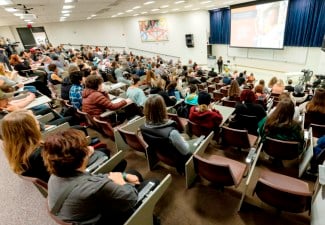
Several hundred students, faculty, staff and community members spent the better half of Monday, Nov. 2 attending workshops, presentations, events and more both in person and via Zoom at SUNY Plattsburgh’s annual Black Solidarity Day Teach-in.
 The university’s full day of programming both in Plattsburgh and at the Queenbury
campus connected community to conversation that centered on racial and social justice,
anti-racism and activism as presenters explored this year’s theme, “Honoring Our Past,
and Empowering Our Future.”
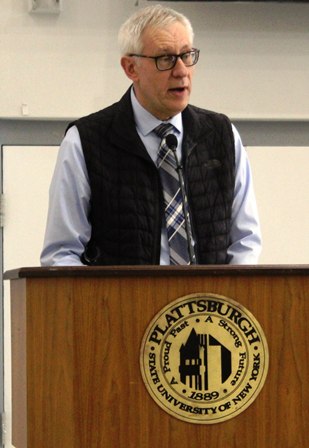
Dr. Alexander Enyedi, university president, and Dr. Dottie Morris, vice president for diversity, equity and inclusion, welcomed those gathered in the Warren Ballrooms in the Angell College Center, encouraging them to make the most of the nearly 50 concurrent sessions — many of which were presented by undergraduate and graduate students.
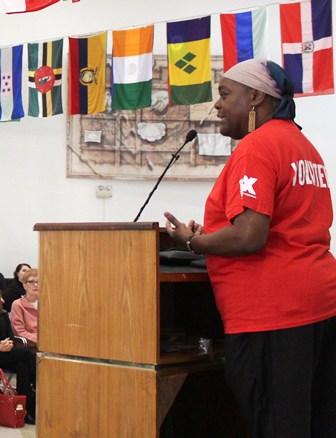 “Black history is American history; it is a part of us all,” Morris said. “So, celebrate
each other and all we have together.”
Morris said she looked forward to “engaging in transformative conversation and just being a community with each other in support of one another. My motto is, ‘You’re never too old to learn, and you’re never too young to teach,’” she said. “Be open to new ideas, and most of all, let’s talk to one another.”
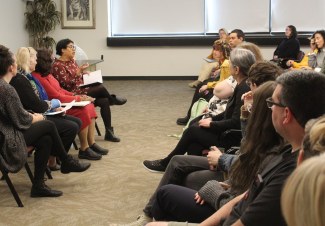
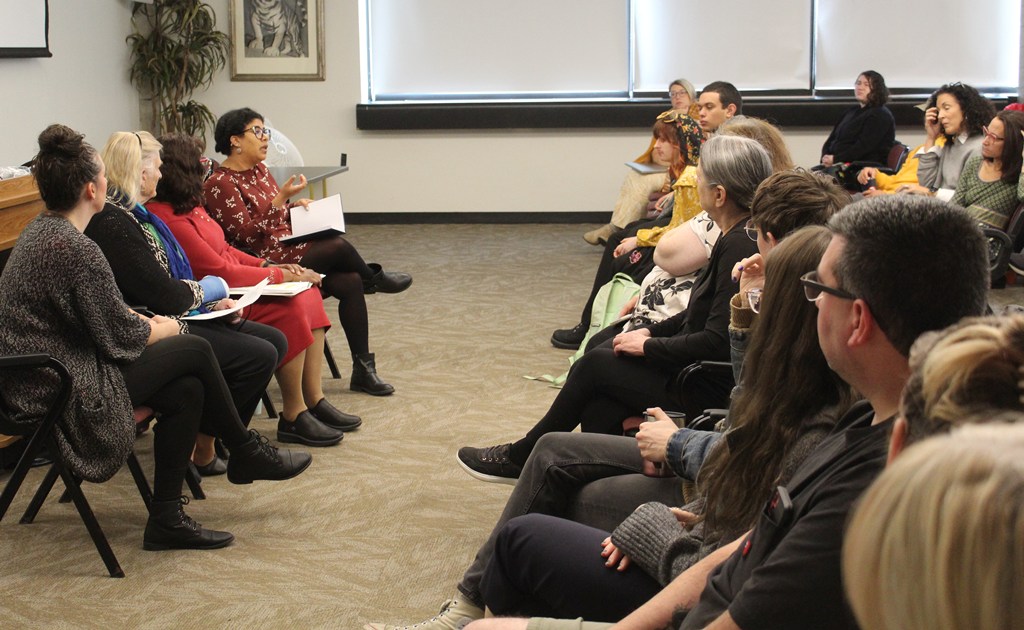
Before break-out sessions began at 10 a.m., Tamara Jolly, community initiatives manager with the Adirondack Diversity Initiative, North Star Underground Railroad Museum President Jacqueline Madison, and Helen Nerska, co-president for the League of Women Voters of the North Country, talked with moderator Bridget Haina, associate professor in communication studies, about how they work to increase civic engagement as well as cultural competency, equity and justice.
Slate of Events Throughout Day
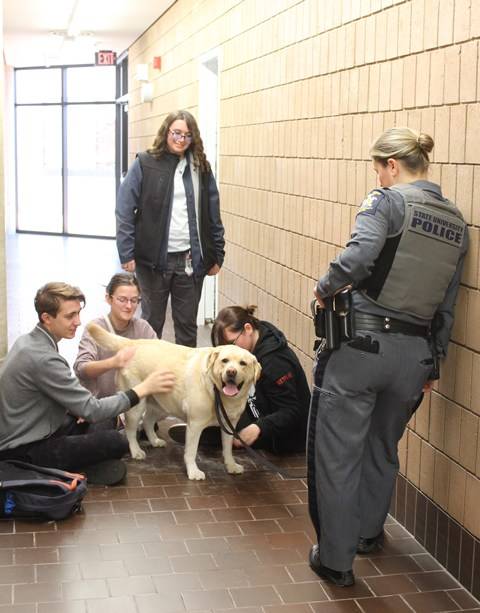 In addition to the opening panel discussion, performances, exhibits, films, and cool-down
sessions with Reva, the University Police therapy dog, participants attended sessions
and conversations such as “Uplifting Black Voices: What Does it Mean to Be an Actively
Anti-Racist Ally?” “Ancestral Wisdom, Storytelling, and Memory: The Antidotes for
Erasure,” “More than a Diagnosis: Race, Identity and Mental Health,” as well as a
final keynote performance by spoken word artist Lyrical Faith, among many more events,
activities and offerings.
 Sessions ran throughout the day in various locations on campus, most of which are
in or in proximity to the Angell College Center, with many being streamed online via
Zoom, including the screening of “Silent Echoes: The Invisible Women,” a documentary
presentation and discussion hosted at the Queensbury campus and on Zoom by Chenique
Boutelle, assistant professor of social work.
The film exposes how systemic neglect, public indifference and institutional bias erase the stories and lives of Black women killed by police violence.
Throughout the 50-minute documentary, the names of victims are interspersed between interviews with advocates in the fight for accountability for the women and girls who have been killed.
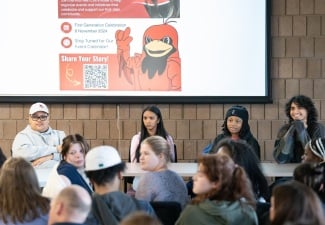
In “Uplifting Black Voices,” SUNY Plattsburgh speech-language pathology grad student Sky Rolnick began their presentation with the words, “I’m not racist,” projected on the screens in the Cardinal Lounge.
“’Not racist’ can become a label we use to define ourselves," Rolnick said. "Identifying as ‘not racist’ does not absolve us of the responsibility to recognize our own capacity for racist and harmful actions.”
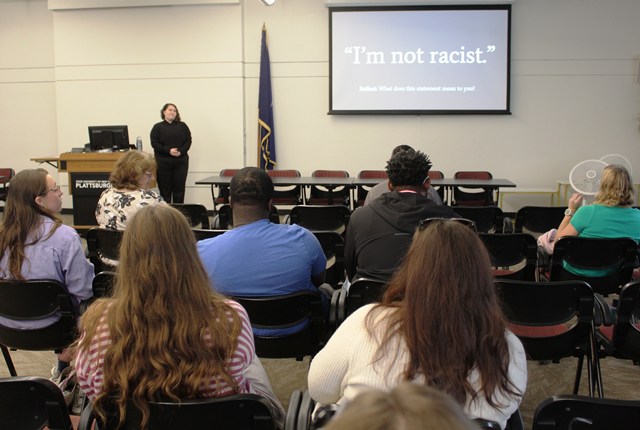 Rolnick said being anti-racist is more than just saying "I can’t be racist because
I say I'm not."
“(It) involves actively examining and challenging racist ideas, actions and systems. Being anti-racist requires ongoing self-reflection and accountability,” they said.
It also requires us to recognize and oppose our own biases and harmful behavior, Rolnick said.
“Examine your own assumptions, biases and privileges. Consider what you would do differently. Listen to feedback without getting defensive. Even if it was unintentional, acknowledge the harm your words may have caused.”
Racism Affects Mental Health
At “More than a Diagnosis,” clinical mental health counseling graduate students Simon Melgarejo, Amanda Castelan and Maggie Meyer facilitated a discussion on how race, racism, identity and social environments can have an impact on mental health.
Using slides that gave participants discussion topics, the presenters took turns asking how racism and discrimination can show up in different ways.
“Sometimes it’s being overlooked, being stereotyped or having your experience be dismissed. But what connects these situations is the emotional and psychological impact they can have on someone,” the presenters said. “Imagine experiencing these situations repeatedly. Over time, these experiences can contribute to stress, anxiety, self-doubt and feelings of isolation.”
 Keynote Performance
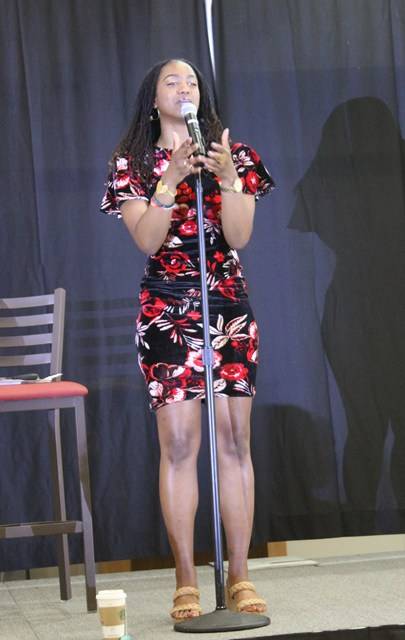
Wrapping up the day-long event was a live performance by Lyrical Faith, who engaged audience members with her spoken word poetry from past works as well as her upcoming debut spoken-word-poetry album, “Lyrical Analysis: The Evidence of Things Unseen.”
Throughout her performance, Faith interspersed her poetry with audience Q&A's, asking them questions as well, such as, "Who are you here for?” and “Who is here for you?”
In explaining how her poetry comes alive onstage — its theatricality — she said simply, “It’s practice.”
“When I look in the mirror, I see what lands where, what beat needs a gesture, a pause. It could be a movement, it could be the way my voice moves,” she said.
Library Exhibit
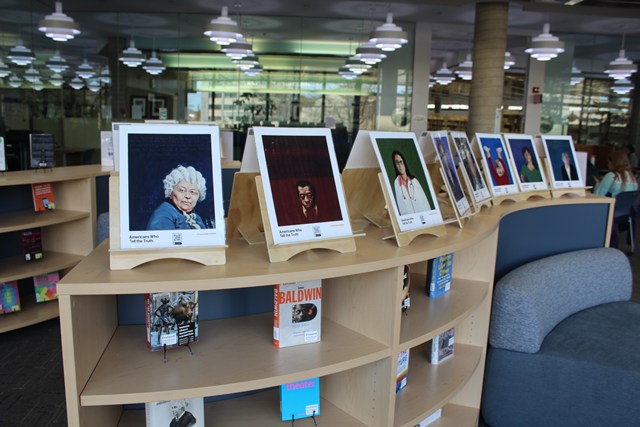
Throughout the day, participants in the teach-in also had the chance to visit the second floor of Feinberg Library where they could see the “Feinberg Library Hosts Americans Who Tell the Truth” portrait exhibit, featuring more than a dozen posters, derived from portraits by artist Robert Shetterly that showcase Americans of various races, genders and backgrounds who have championed the courage to uphold democracy and the American Dream. “Americans Who Tell the Truth” will remain on display through Nov. 20.
— Story, Photos by Associate Director of Communications Gerianne Downs