SUNY Plattsburgh Alumna’s Career Takes Her to the Moon and Back Again
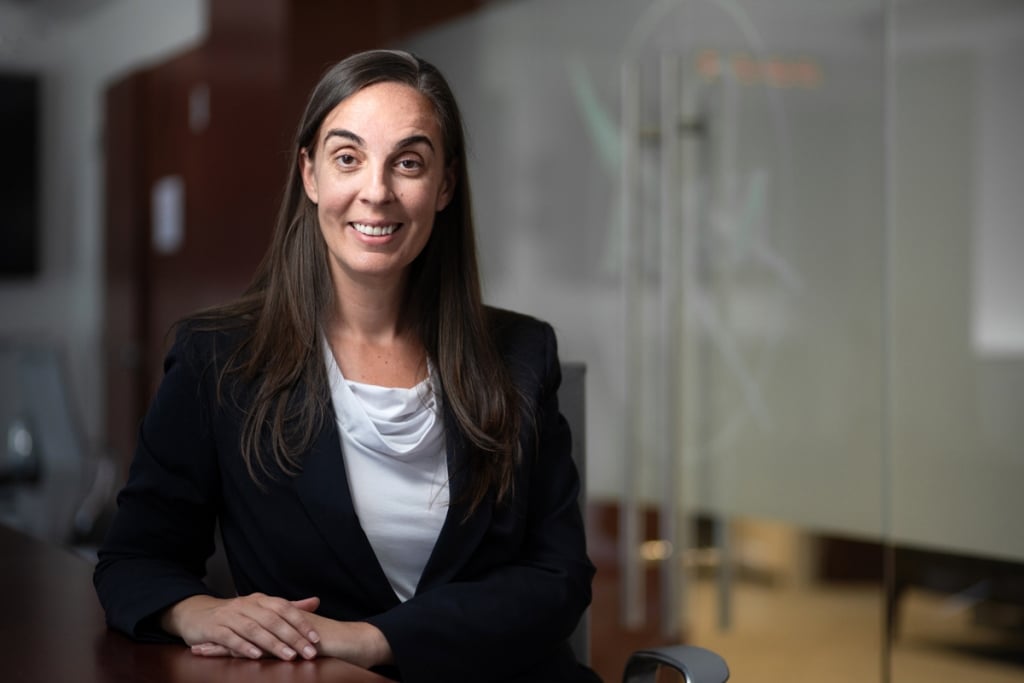
No one, least of all Jena Garrahy, thought she would end up overseeing communications that kept the Artemis II spacecraft in touch with Earth as it made its historic way to the moon and back over 10 days in April.
She came to SUNY Plattsburgh to be a teacher.
The 2004 grad from St. Lawrence County said she thought she had her life planned out.
“I intended to become a teacher, largely because so many members of my family worked in education, and I assumed it would be the right fit for me as well,” she said. “(But) one of the greatest gifts Plattsburgh gave me was the opportunity to explore.”
She did this through the university’s general education courses, which exposed her to different disciplines, she said.
“I realized I was energized by international cultures, travel and global business,” Garrahy said. “I changed my major to international business, and that decision ultimately changed the trajectory of my career. If you had told freshman-year me that one day I’d be leading operations for NASA’s global communications networks and supporting missions to the moon, I never would have believed you.”
NASA wasn’t even on her radar.
“My career has been built by saying ‘yes’ to opportunities that challenged me, even when they weren’t part of my original plan,” she said.
‘Yes’ Moments
Garrahy, who is the deputy program manager for operations for NASA’s Space Communications and Navigation Program, said those “yes” moments came about as the result of a Craigslist job posting.
“After earning my master’s degree at Bond University (Australia), I moved to the San Francisco Bay area, looking for my first professional opportunity,” she said. She saw the job posting, where “a small consulting firm was looking for a recent graduate who could research, analyze information and write reports.”
Garrahy applied, was hired and began supporting Department of Defense efforts as a contractor.
 “That role took me all over the country and introduced me to incredible mentors. During
one assignment, I met a vice president of another company who appreciated my work
ethic and later recruited me to support a NASA contract at Goddard Space Flight Center.”
“That role took me all over the country and introduced me to incredible mentors. During
one assignment, I met a vice president of another company who appreciated my work
ethic and later recruited me to support a NASA contract at Goddard Space Flight Center.”
Goddard is described by NASA is its “premier space flight complex and home to the nation’s largest organization of scientists, engineers, and technologists who build spacecraft, instruments, and new technology to study Earth, the Sun, our solar system, and the universe.”
Challenging Roles
Garrahy joined the Goddard team in 2009 during which she took on “increasingly challenging roles across NASA’s communications programs,” she said. “When my longtime supervisor became a NASA civil servant, I eventually followed that path myself, joining NASA headquarters as a civil servant in 2017.”
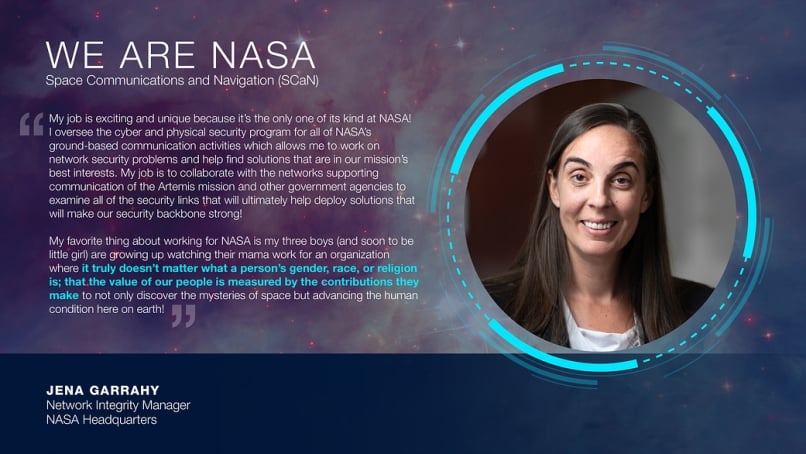
As its deputy program manager for its SCaN program, Garrahy oversees the Near Space Network, the Deep Space Network, and NASA’s tracking and data relay satellite system, “essentially the communications backbone that allows NASA missions to talk to Earth, whether they’re orbiting the International Space Station or exploring the far reaches of our solar system,” she said.
With Artemis II, Garrahy said it felt like being part of history in the making.
“My role was to oversee the communications infrastructure that keeps the Orion spacecraft connected to Earth — from the time it’s sitting on the launch pad, through launch, the journey to the Moon, around the far side where communications temporarily cease, and then reconnecting as Orion comes back into view before returning safely to Earth,” she said.
“Most people think of rockets and astronauts when they think NASA, but none of those missions happen without reliable communications. Knowing that my team plays a critical role in every minute of that mission is both humbling and incredibly rewarding,” Garrahy said.
 But looking back on her career, none of this was planned, she said.
“It has been a career built on curiosity, hard work, incredible mentors and being willing to take on opportunities that stretched me. I wasn’t the student most people would have predicted would end up at NASA, but I have had an incredibly successful career going the non-traditional path to getting here,” Garrahy said.
Academically, Garrahy said she learned how to think critically, solve problems and communicate effectively.
“But some of the most valuable lessons happened outside the classroom. Working as a teaching assistant taught me responsibility, organization and how to explain complex ideas to others, skills I use everyday as a leader,” she said. “I also realized that success isn’t always about having the highest GPA. It’s about learning how to work with people, adapting when things don’t go as planned and taking advantage of opportunities when they come your way. Those lessons have served me far more than memorizing facts ever could. I am a leader in a STEM-dominated field but with a non-STEM degree.”
Garrahy also credits the leadership experience cultivated through Greek life at SUNY Plattsburgh, having joined Alpha Phi during sophomore year.
‘Looking for Community’
“I was looking for community, but I walked away with so much more than lifelong friendships,” she said. “Serving as chapter president during my senior year was my first real leadership experience. I learned how to motivate people with different personalities, resolve conflict, manage budgets, plan events, and lead an organization through both successes and challenges.
“Looking back, those experiences were some of my earliest leadership training. Ironically, I use many of those same skills today at NASA,” Garrahy said. “Technological knowledge is important, but leadership is ultimately about building trust, communicating clearly, bringing people together and helping teams accomplish something bigger than themselves.”
Working as a teaching assistant became what she called “one of the most meaningful experiences of my time at Plattsburgh.”
“It taught me patience, accountability and how to support others in their learning. What I was most passionate about was building relationships,” she said. “Looking back, the people I met at Plattsburgh — classmates, professors and mentors — had just as much impact on my future as my textbook did.
“SUNY Plattsburgh gave me much more than a degree,” Garrahy said. “It gave me confidence, lifelong friendships, leadership opportunities and the courage to pursue experiences I never imagined. Those experiences ultimately led me to NASA, and for that I’ll always be grateful.”
— By Associate Director of Communications Gerianne Downs; NASA Photos Provided