Faculty Give Students ‘Object Lessons’ with Help of Plattsburgh State Art Museum
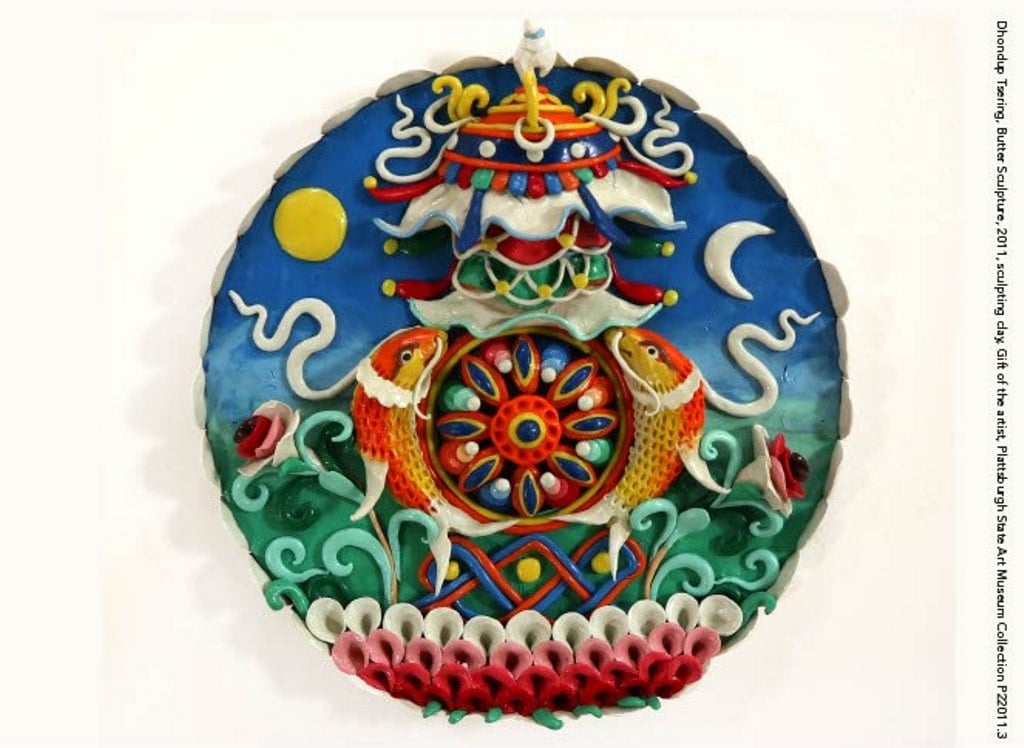
The Plattsburgh State Art Gallery has combined collaboration with collections, turning the Slatkin Study Room into a working laboratory for three faculty members and their students through the exhibit, “Object Lessons: Lines, Place, Persuasion.”
Working with Kara Jefts, manager of collections and academic engagement, Mark Baran, instructional support technician in the Center for Earth and Environmental Science, Dr. Amy Mountcastle, professor and co-chair of anthropology, and Norman Tabor, professor in art and design, are using objects brought together from the museum’s collection for classes taught in their respective disciplines.
Jefts brought together objects used in classes on mapping, Tibetan culture, and graphic design to highlight how visual materials can function “as tools for inquiry with expansive narratives.”
“Lines are the way knowledge is drawn, quite literally, from the border marks of maps to sacred imagery and calligraphy and the graphic strategies of poser design,” Jefts said. “Place is constructed as much through belief and heritage as through geography, revealing how spaces are constructed, claimed and charted.
“Persuasion highlights the power of images to shape perception, whether through scientific authority, spiritual instruction or political messaging,” she said.
Primary Tools for Learning
Tonya Cribb, museum director, said the campus itself “broadly appreciates the aesthetic qualities of the art collection, but we hope to emphasize that this is an academic collection that helps all students by fostering creativity, critical thinking, emotional intelligence and cultural understanding,” she said. “We want faculty to recognize that these artworks serve as primary tools for exploring complex ideas, no matter what their major. It’s also a fun way to learn.”
Baran worked with Jefts to find several pieces in the collection that could be considered maps or that incorporated “spatial data for students to look through and consider their purpose and potential bias,” he said.
In his lecture prior to investigation of the collection, Baran said the students went through “the ways that people lie with maps, either out of cartographic necessity, errors or with nefarious purposes. This project allowed us to continue that (conversation) with physical examples.
“Maps, like all forms of media, are designed to tell a story to their target audience,” he said. “As with any story, a map’s message is inextricably tied to the inherent objectives and biases of its creator; every map tells the story that its cartographer wants its readers to see.
“In maps, these biases can come through in the choice of data layers and features shown, usage of symbology and text, map projection, extent, level of detail — scale — and artistic license.”
Baran’s students were then asked to look closely at each of the five pieces selected.
They were asked “to think about which features were shown on them, how they were shown, what data is lacking that could tell a different story, and the overall purpose of the map based on those other things.”
Tibetan Artworks
Mountcastle asked both Jefts and Cribb if she could access art pieces acquired during the three Festival of Tibetan Arts and Culture exhibits that took place on campus from 2010 to 2015, “so that students in my course, ANT307 Tibetan Peoples of the Himalayas, could have the opportunity to see this work in person,” she said.
“I built into the course syllabus a couple of weeks of concentration on Tibetan arts and asked students to look at the works on display and then choose one or two of particular interest to them to discuss from a personal/subjective viewpoint and from a comparative viewpoint with some other Tibetan art or expressive cultural form of their choosing,” Mountcastle said.
The artworks provided a jumping-off point for discussing several aspects of the Tibetan cultural world: Tibetan religious culture and its influence on everyday Tibetan life; the arts and Tibetan exile; secular and religious cultural expression, to name some of them, she said.
“It also gives me an opportunity to connect students with the museum in a more general way, and it also enables me to bring Tibetan culture and Tibetan people closer to home, as I can reminisce about the artists coming to campus, building sand mandalas, giving talks, and doing cultural ceremonies on campus,” Mountcastle said.
“Some of the pieces in the Plattsburgh State Art Museum collection were made, at least in part, in situ, while the artists were on campus during the festivals, and I can tell stories of their interactions with guests to the museum at the time.”
Moral Compass
In Taber’s introduction to graphic design class, students are asked to look at their responsibility as visual communicators. Graphic designers “are educated in the use of visual metaphor and design principles, often to communicate the ideas of others,” he said. “With this skill comes responsibility — it is important that the designer set their moral compass early in their career and revisit it often.”
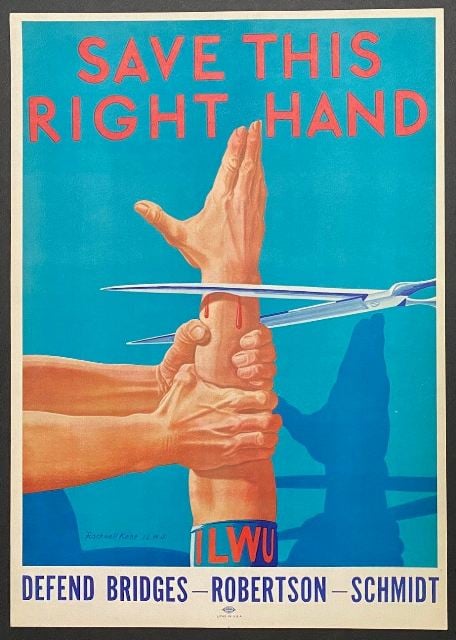 As a result, Taber chose images because they demonstrate designers involved in social
and political messaging.
As a result, Taber chose images because they demonstrate designers involved in social
and political messaging.
Rockwell Kent’s poster, “Save this Right Hand,” offers the viewer “a disturbing and pedestrian stopping image. Out of context of its day, its meaning may be lost on the casual observer, but the issues it addresses are timely,” he said.
The poster is a call to action to defend Harry Bridges, an Australian immigrant and naturalized citizen of the United States who fell under scrutiny after rising in his leadership in the International Longshoreman’s Warehouse Union. He was convicted by a federal jury of lying about his membership in the Communist Party when applying for naturalization and faced deportation.
Metaphorical Image
Taber said that to understand the poster, “you might have to fully understand the visual and metaphorical vocabulary of the day and the role biblical faith played in America.”
Jesus instructing, “And if thy right hand offend thee, cut it off, and cast it from thee,” is a metaphor for casting out sin, not literally cutting off your right hand.
“Seeing labor and the immigration as the working ‘right hand’ of the United States, the viewer is confronted with the horror of the implantation of the verse,” Tabor said. “Cutting and casting off the right hand — immigrant labor — of the United States for a perceived and trumped-up offense would cause the United States to be traumatized and less able to proceed with the essential work before it.”
Bridges’ case went before the Supreme Court where it was overturned in 1953. He remained active in the union until his retirement in 1977. He died in 1990 at the age of 88.
“Having this space, away from screens, provides us an opportunity for the students and me to engage directly with the art and the creative process,” Taber said. “It is a unique opportunity we can offer our students.” He thanked Jefts “for helping me locate, prepare and display the images in this show.”
“While the selections on display focus on distinct class subjects, ‘Object Lessons’ invites cross comparison,” Jefts said. “By looking closely at the works on view we can recognize how visual strategies shape how worlds are mapped, cultures are represented, and political concepts are made convincing.”
“Object Lessons: Lines, Place, Persuasion,” is open through May 16 in the Slatkin Study Room, 2nd floor, Myers Fine Arts Building.
For more information, contact Jefts at 518-564-2496 or email [email protected].
— By Associate Director of Communication Gerianne Downs; Images Provided