Campus Illuminates Hawkins, Supports Breast Cancer Awareness Month Message
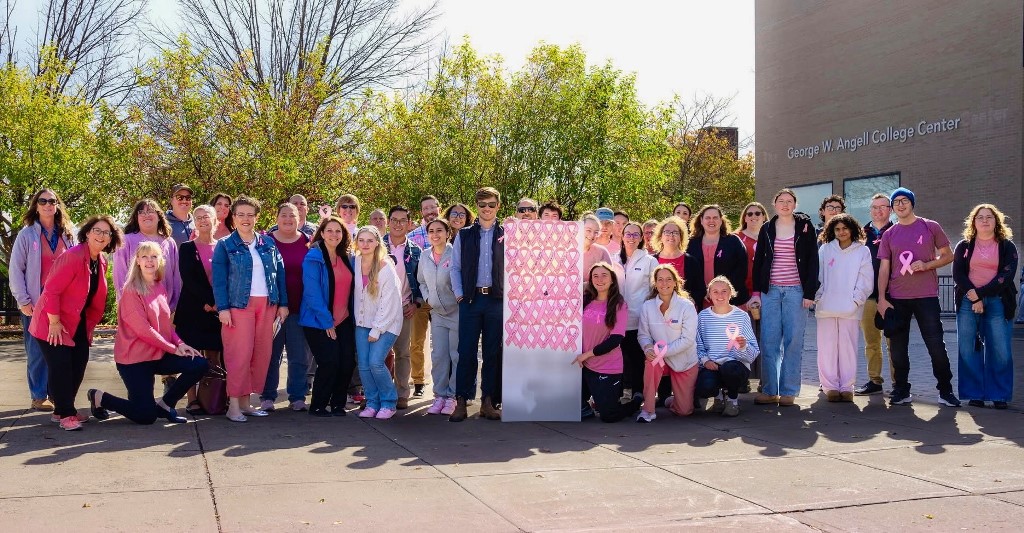
SUNY Plattsburgh is in lockstep with the Breast Cancer Awareness Month campaign, having “pinked” the front of Hawkins Hall and the campus Oct. 15 when Wellness and Health Promotion encouraged students, faculty and staff to wear pink.
That day, pink ribbons were distributed followed by a group photo and a Saranac River Trail walk.
 To recognize the two million-plus women around the world diagnosed with breast cancer
each year, October has long been designated as Breast Cancer Awareness Month. An international
health campaign, Breast Cancer Awareness Month aims to promote screening and reduce
the risk of the disease.
To recognize the two million-plus women around the world diagnosed with breast cancer
each year, October has long been designated as Breast Cancer Awareness Month. An international
health campaign, Breast Cancer Awareness Month aims to promote screening and reduce
the risk of the disease.
Breast Cancer Awareness Month began in 1985 as a week-long campaign launched by the American Cancer Society in partnership with the British company, Imperial Chemical Industries, the makers of tamoxifen. That week eventually grew into a month-long event.
In 1992, the pink ribbon came to represent breast cancer as a symbol of breast cancer and the women and men who are battling the disease, surviving the disease and who have perished from the disease.
Breast Cancer Awareness Month:
- Supports people diagnosed with breast cancer, including those with metastatic breast cancer
- Educates people about breast cancer risk factors
- Encourages women to go for regular breast cancer screening starting at 40 years old or earlier, depending on personal risks
- Raise funds for cancer research
During October, there are specific dates designed to raise awareness as well, including Metastatic Breast Cancer Day Oct. 13 and Men’s Breast Cancer Awareness Week Oct. 17-23.
According to Breastcancer.org, people of every country, race, ethnic group and income level are affected by breast cancer. In the U.S., the percentage of women diagnosed with breast cancer has been slowly rising for the past couple of decades.
- A woman in the United States today has a 1 in 8 chance of developing breast cancer over her lifetime and a 1 in 43 chance of dying from breast cancer
- Nearly 30 percent of women diagnosed with early stage breast cancer later develop metastatic breast cancer
- Lesbian, gay and bisexual cisgender women may have a higher risk of breast cancer than heterosexual women due to risk factors like fewer childbirths and higher alcohol use
- The average lifetime risk that a man in the United States will develop breast cancer is 1 in 726
- Transfeminine people taking gender-affirming hormone therapy, including estrogen, are at a higher risk of developing breast cancer than cisgender men
- There are about four million breast cancer survivors in the United States, including women receiving breast cancer treatment
- While the percentage of women dying from breast cancer has gone down in recent decades, Black women remain more likely to die from breast cancer than women of any other racial or ethnic group
- Breast cancer is the most common cancer diagnosed among women in the United States. Each year, about 32 percent of all newly diagnosed cancers in women are breast cancer
- In 2025, some 316,950 women will be diagnosed with invasive breast cancer, with 59,080 new cases of ductal carcinoma in situ (DCIS), which is non-invasive
- About 16 percent of women with breast cancer are younger than 50 years of age
- About 66 percent of breast cancer cases are diagnosed at a localized stage — before cancer has spread outside of the breast — when treatments tend to work better
- Female breast cancer incidence rates have been slowly increasing since the mid-2000s, largely driven by diagnoses of localized-stage and hormone receptor-positive disease
- There are currently more than four million women with a history of breast cancer in the U.S. This includes women currently being treated and women who have finished treatment
- About 42,170 women will die from breast cancer in 2025
- Less than 1 percent of all breast cancers occur in men
— By Associate Director of Communications Gerianne Downs
— Photo by Hunter Mossey, multimedia coordinator